
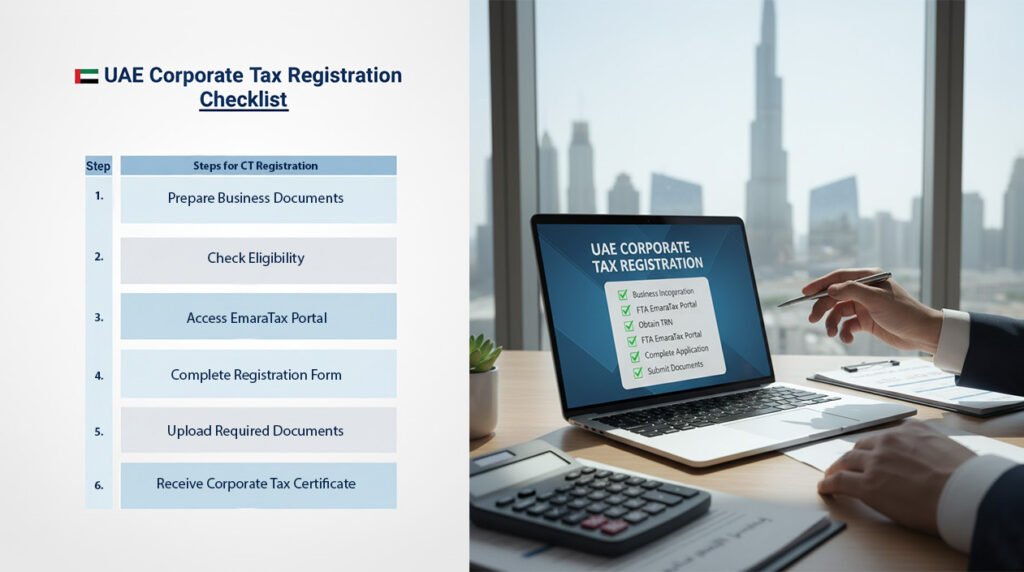
The United Arab Emirates (UAE) has historically been known for its tax-friendly environment. However, with the introduction of Corporate Tax in the UAE effective for financial years starting on or after June 1, 2023, businesses now need to understand and comply with new regulations. This significant shift makes corporate tax registration in the UAE a critical process for nearly all entities operating within the Emirates.
Why is Corporate Tax Registration Now Essential in the UAE?
The implementation of Corporate Tax in the UAE aligns the nation with international best practices and strengthens its position on the global economic stage. For your business, this means:
- Mandatory Compliance: Most businesses (with specific exemptions) are now required to register for Corporate Tax. Failure to do so can result in penalties.
- Legal Operation: Proper registration ensures your business operates legally under the new tax regime.
- Transparency and Trust: Demonstrating compliance enhances your business’s credibility with local authorities, partners, and investors.
- Future-Proofing Your Business: Adapting to the new tax landscape positions your company for sustainable growth in the evolving UAE economy.
Who Needs to Register for Corporate Tax in the UAE?
Generally, the following entities are required to register:
- UAE-incorporated companies and foreign companies effectively managed in the UAE.
- Foreign companies with a Permanent Establishment in the UAE.
- Non-residents earning UAE-sourced income.
- Non-resident companies earning income from UAE immovable property.
- Individuals conducting business in the UAE with annual turnover over AED 1,000,000.
Key Exemptions (Always consult official guidance for full details):
Certain entities are exempt or may not need to register, such as:
- Government entities and government-controlled entities.
- Public benefit entities.
- Investment funds that meet specific conditions.
- Entities engaged in the extraction of natural resources (which are generally subject to Emirate-level taxation).
- Individuals earning employment income, real estate income (not requiring a license), or investment income.
Steps for Corporate Tax Registration in the UAE:
The Federal Tax Authority (FTA) is responsible for the administration of Corporate Tax. Here’s a general outline of the registration process
- Access the FTA EmaraTax Portal: The registration process is primarily conducted online through the FTA’s integrated EmaraTax digital platform.
- Create an Account/Log In: If you don’t have an existing account, you’ll need to create one. Existing VAT registrants can use their current credentials.
- Complete the Corporate Tax Registration Application: This involves providing detailed information about your business, including:
- Company details (name, legal form, trade license number).
- Business activities.
- Financial year-end.
- Details of owners/shareholders.
- Contact information.
- Submit Required Documents: You will need to upload supporting documents, which typically include:
- Trade License copy.
- Memorandum of Association (MOA) / Articles of Association (AOA).
- Emirates ID/Passport copies of owners/authorized signatories.
- Bank account details.
- Review and Confirmation: Once submitted, the FTA will review your application. Upon approval, your business will be officially registered for Corporate Tax and issued with the unique TRN and Corporate tax registration certificate.
Important Considerations for Businesses in Free Zones:
Free Zone companies are generally subject to UAE Corporate Tax. However, a “Qualifying Free Zone Person” (meeting specific conditions related to substance, qualifying income, and non-reliance on mainland customers) can benefit from a 0% Corporate Tax rate on their qualifying income. Even if your Free Zone entity expects a 0% rate, corporate tax registration in the UAE is still a mandatory requirement.
Key Dates and Deadlines:
Companies established before 1 March 2024: The FTA will provide a registration deadline. You can check this through your EmaraTax portal.
Companies formed on or after 1 March 2024: You must complete your corporate tax registration within 3 months of obtaining your business license.
Freelancers, influencers, and self-employed individuals earning over AED 1 million annually are also required to register.
⚠️ Missed the deadline? A late registration triggers an automatic AED 10,000 penalty.
First Corporate Tax Return Filing Deadlines
Once registered, the first corporate tax return also has a deadline:
- If your financial year ends on 31 December 2024, your first return must be filed by 30 September 2025.
- This gives businesses the standard 9-month window, but meeting this deadline is crucial to avoid penalties and interest.
Expert Tip: Given the complexities of defining “Qualifying Income” for Free Zone entities and understanding specific exemptions and deductions, engaging with a reputable tax consultant is highly recommended. They can help ensure accurate registration and compliance, optimizing your tax position.
How Finexus Advisory Helps
Navigating corporate tax regulations can be complex. At Finexus Advisory, we provide comprehensive corporate tax consulting and compliance services tailored to your business needs.
Our services include:
- Corporate Tax registration
- Corporate Tax filing
- Corporate Tax De-registration
- Tax planning and impact assessment
- Reviewing free zone entity qualifications
- Preparation of financial statements and audit coordination
- Ongoing compliance and advisory support
We ensure your business remains compliant, optimized, and ready for the future of taxation in the UAE.
Your Business Needs Corporate Tax Compliance – Your Solution is Finexus.
Contact Finexus Advisory today and stay compliant with UAE laws while improving your financial performance.